

Table of Contents
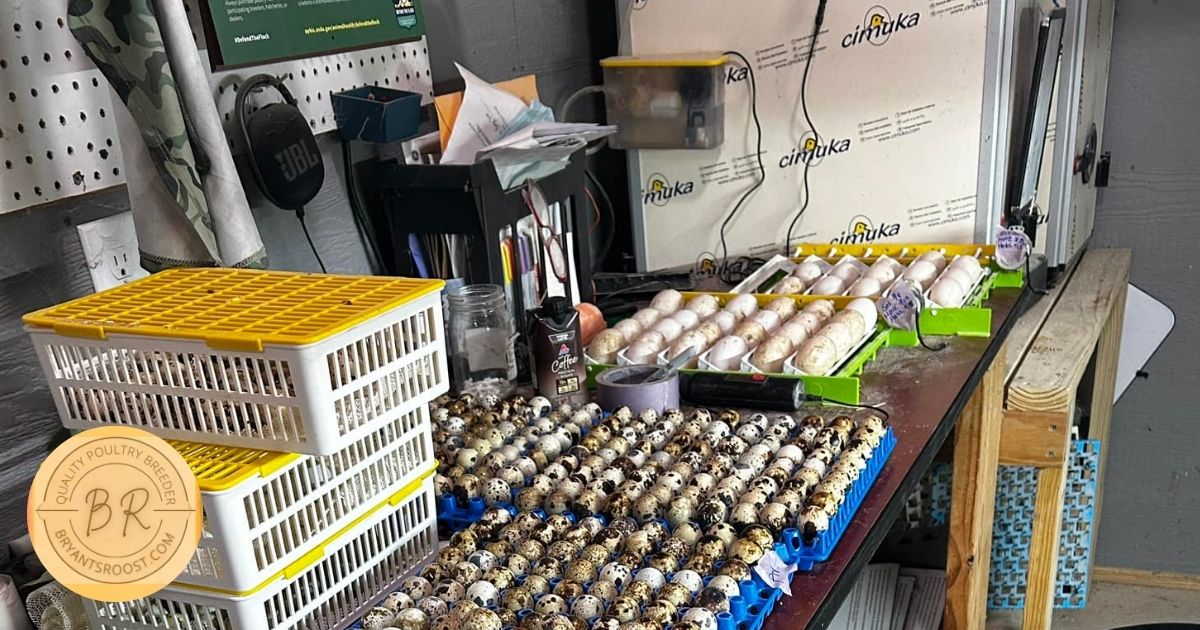
In Bell Buckle, Tennessee, Jennifer Bryant and her husband run Bryant's Roost, where hatching eggs and helping other poultry keepers hatch successfully are part of their daily work. In July 2023, Jennifer decided to put several incubators to the test using her prized jumbo Coturnix hatching eggs.
She had a practical reason for doing it. Customers regularly asked which incubators she would recommend at different price points, and Jennifer wanted hands-on experience with several machines before answering them.
Her experiment included cabinet and tabletop incubators from Hatching Time, GQF, Brinsea, Maticoopx, Nurture Right, and several generic or styrofoam models. Jennifer also made one point clear from the beginning: no company influenced the results or contributed financially to the experiment.
You can read Bryant's Roost's original incubator experiment in full. Below, we're looking at how Jennifer ran the test, what she experienced with the different incubators, and where each one finished.
How the Experiment Was Set Up
Jennifer selected one egg from 21 different breeding sets for each incubator. This gave each group eggs drawn from the same broader breeding stock rather than loading one incubator from one breeding set and another from a completely different group.
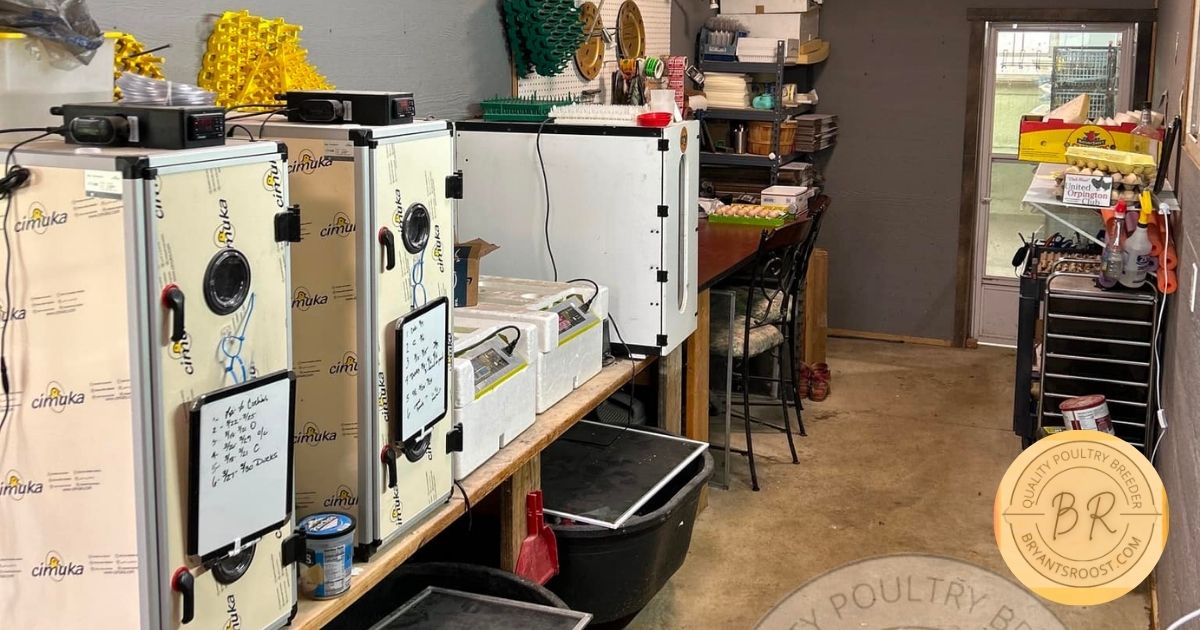
Because she had several incubators to test, Jennifer divided the experiment into two phases, three weeks apart. The machines were set on plastic shelving in her barn office, where the room temperature was held at 74°F.
Each incubator was turned on for 24 hours before the eggs were loaded. Jennifer began with the factory settings because she wanted to imitate the experience of someone relatively new to using the machine rather than fine-tuning every incubator in advance.
She also placed a Govee thermometer inside each incubator for several days to take sample readings.
Hatch rate wasn't the only thing she considered. Jennifer looked at how easy each incubator was to operate and clean, how it handled temperature and humidity, and what happened when she tried to contact each manufacturer with a question or issue.
At the end of incubation, she separated the eggs into three groups: hatched, unfertilized, and dead in shell or quitters. Jennifer reported an average of 3.9 eggs per group that were either unfertilized or very early quitters. She did not include those eggs in the hatch rates used for her final comparison.
If you're still getting comfortable with egg positioning, turning, temperature, humidity, and the other variables involved in a hatch, our guide to properly incubating poultry eggs covers those fundamentals separately.
What Jennifer Found
The comparison became more useful once Jennifer started working with the machines because some of the differences had little to do with the specifications on the box.
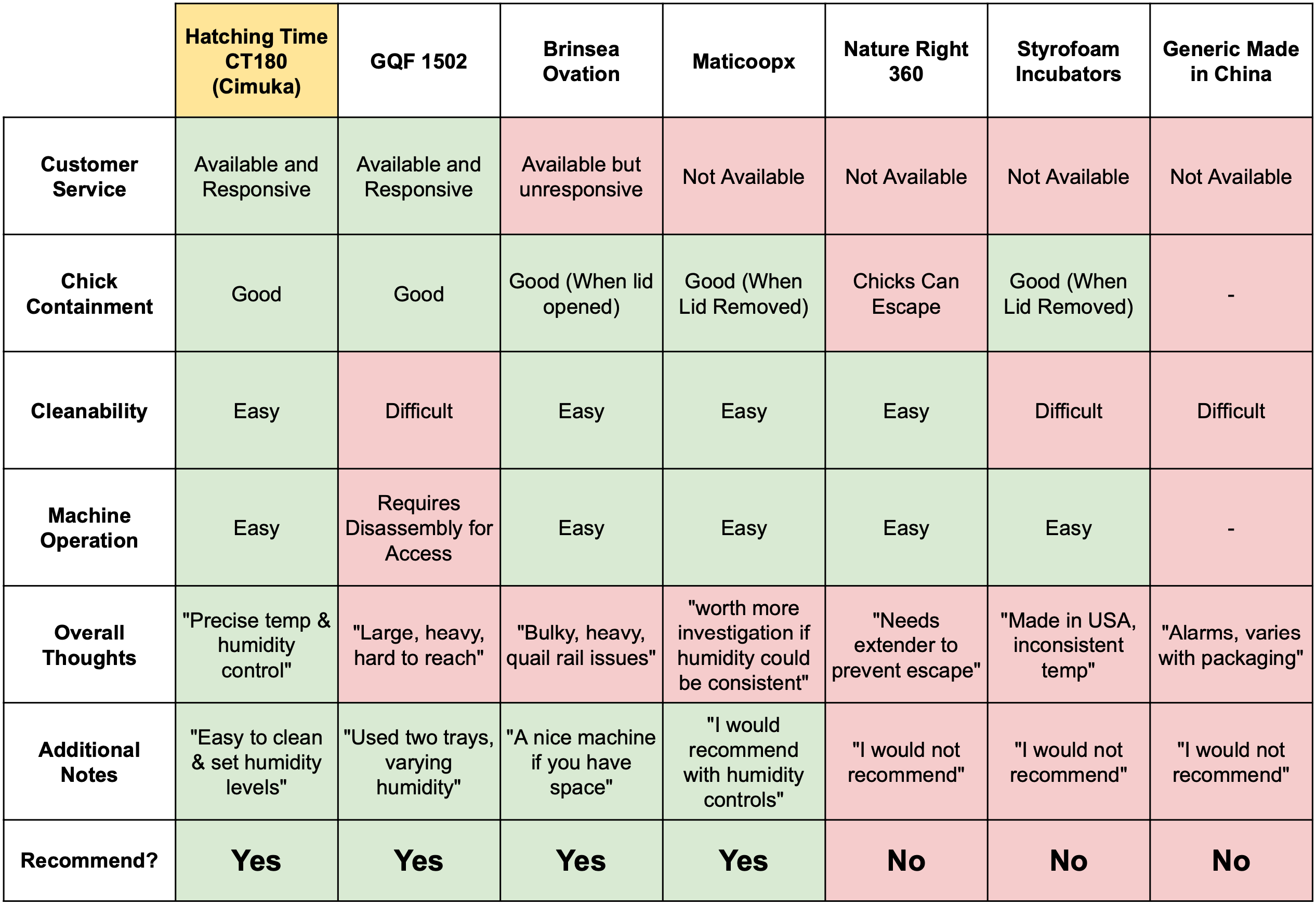
With the Nurture Right 360, she found the machine fairly self-explanatory and easy to clean. Her bigger concern came when the lid was removed, because chicks could run out and fall. One of the three units had an extender that prevented this problem. Jennifer also wasn't able to locate a customer service phone number or email during her test.
The Maticoopx was easy for Jennifer to operate and clean, and the chicks remained contained when the lid was removed. She again had difficulty locating customer service contact information. Its hatch rate was lower than several of the other machines, but Jennifer didn't completely write it off. She thought it could be worth further investigation if humidity could be kept consistent.
Her experience with the styrofoam and generic incubators was less positive. Jennifer reported cleaning difficulties, inconsistent temperature in the Made in USA styrofoam model, and recurring alarms in the generic Made in China units regardless of their settings.
The Brinsea Ovation performed much better. Jennifer found it easy to operate and clean, and chicks stayed contained when she opened the lid. She did feel the machine was relatively large and heavy for its capacity, and her jumbo Coturnix eggs didn't fit the quail rails particularly well. Still, its 80% hatch rate was one of the strongest results in the experiment.
Jennifer also had positive things to say about the GQF 1502. Customer service answered her questions promptly and thoroughly, and she considered its egg capacity a major strength. Her biggest issue was cleaning access. She found that some work had to be done from behind the cabinet, screws had to be removed, and the depth made parts of the machine difficult for her to reach during a deep clean.
With the Hatching Time CT180SH, Jennifer reported prompt answers from customer service and found the machine easy to operate. Although the cabinet still needs room for rear access, she could reach the back from the front and found that she could clean the unit fully from the front. She also reported very consistent temperature and humidity during her test.
The comparison chart below summarizes Jennifer's experience across the different incubators.

CT180SH vs GQF 1502
The Hatching Time CT180SH and GQF 1502 make an especially interesting comparison because both give poultry keepers cabinet-style capacity, but Jennifer's experience with the two machines was different.
Capacity was where the GQF stood out for her. In fact, Jennifer called the GQF 1502 the "hands down" capacity machine. She also received prompt and thorough answers when she contacted GQF customer service.
Cleaning was where she ran into difficulty. Jennifer found the GQF deeper than she could comfortably reach, and some maintenance required access from behind the machine and the removal of screws. She said the areas she could reach were easy to clean, but a complete deep clean required more space and time.
Jennifer also received prompt customer service responses from Hatching Time. With the CT180SH, she found she could reach the rear of the cabinet from the front and clean the machine fully from the front. She described it as easy to operate and reported that it held temperature and humidity very consistently during her experiment.
The two GQF groups produced hatch rates of 54% and 65%. Jennifer's Hatching Time groups produced 63% without turning and 85% with turning.
Hatch Rate Results
Jennifer recorded the following hatch rates after excluding eggs she classified as unfertilized or very early quitters:
- Hatching Time with turning: 85%
- Brinsea: 80%
- GQF, dry/wet: 65%
- Hatching Time without turning: 63%
- Generic Made in China without styrofoam: 59%
- GQF, dry/dry: 54%
- Nurture Right 360: 47%, 37.5%, and 6% across the three machines
- Maticoopx: 24%
- Made in USA styrofoam incubator: 19%
- Generic Made in China with styrofoam: 0%
The Hatching Time group with turning produced the highest hatch rate in Jennifer's experiment at 85%, followed by the Brinsea at 80%. The strongest GQF group reached 65%.
How to Read the Results
Hatch rate matters, but Jennifer's experiment also shows why one percentage can't tell you everything about an incubator.
She intentionally started with factory settings because she wanted to see what someone relatively new to each machine might experience. She also tested several different incubator styles and configurations rather than trying to create a laboratory test where every variable was identical.
And hatch rates can change. Fertility, egg storage and handling, turning, temperature, humidity, egg size, and conditions during the hatch can all affect the outcome.
So the 85% result is best read for what it is: Jennifer recorded an 85% hatch rate in the turning group of the Hatching Time incubator during this experiment. It isn't a promise that every CT180SH hatch will produce exactly the same percentage, just as the results from the other incubators don't define what every future hatch in those machines will look like.
What makes Jennifer's experiment particularly useful is the combination of those hatch rates with what she experienced while actually living with the machines: cleaning them, opening them, working around them, managing humidity, and contacting the manufacturers when she needed help.
Jennifer's Conclusion
Jennifer's final assessment wasn't simply that every incubator other than Hatching Time failed.
She described the Brinsea as a nice machine and said she would suggest it when its capacity, size, and price worked for the person using it. She saw the GQF 1502 as the standout choice for capacity, although her experience cleaning it made her reluctant to use it as a hatcher. And despite the Maticoopx's 24% result, she thought it was worth investigating further if humidity could be kept consistent.
Her conclusion about the Hatching Time machine was the strongest. After looking at the hatch results alongside temperature and humidity consistency, cleaning, maintenance, and operation, Jennifer called it the "ultimate winner" of her experiment.
That was Jennifer's conclusion from a comparison she designed and conducted independently. Hatching Time had no affiliation with it.
If you're comparing cabinet sizes for your own flock, you can browse the CT Incubator collection to compare the CT60, CT120, and CT180 options.
You can also explore our smart automatic egg incubators if you're comparing automated incubation options across different capacities and setups.
If you're still deciding whether a cabinet incubator, tabletop model, or another setup makes the most sense for the eggs you hatch, our Best Egg Incubator guide looks at the broader decision.
References
- Bryant's Roost, 2023 Incubator Experiment: https://bryantsroost.com/experiments


