
- What Should You Use to Transport Chickens?
- How Many Chickens Can You Transport at Once?
- How to Prepare Chickens Before Transport
- How to Load Chickens Into a Transport Coop
- How to Transport Chickens in a Car
- Short Trips vs. Long-Distance Chicken Transport
- Heat, Cold and Ventilation During Chicken Transport
- Which Chicken Transport Coop Fits Your Flock?
- Transporting Turkeys, Quail, Pigeons and Game Birds
- Transporting Chickens Across State Lines
- Unloading Chickens After the Trip
- Cleaning and Disinfecting Poultry Transport Coops
- Common Chicken Transport Mistakes
Moving anything from one place to another comes with a little stress. You have to think about timing, space, weather, what fits where, and what could go wrong along the way.
When what you’re moving is alive, that stress goes up faster.
Chickens don’t understand why they’re being caught, placed into a carrier, loaded into a vehicle, and taken somewhere unfamiliar. Even a short trip can turn messy if the carrier is wrong, the airflow is poor, or you start loading before the vehicle is actually ready.
That’s why chicken transport is mostly about thinking ahead.
How many birds are you moving? How long will they be in the carrier? What will the weather be like? Can the crates sit securely without blocking ventilation? And when you arrive, where are the birds going next?
If you can answer those questions before you catch the first chicken, the trip usually becomes much easier.

What Should You Use to Transport Chickens?
You can move a chicken in all kinds of containers, but that doesn’t mean every container is a good choice.
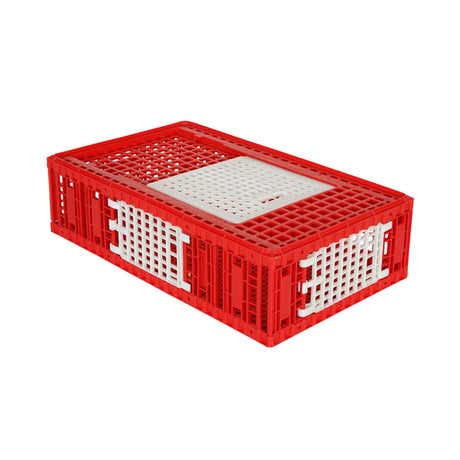
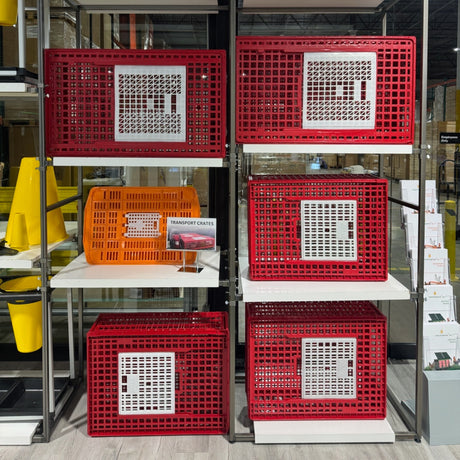
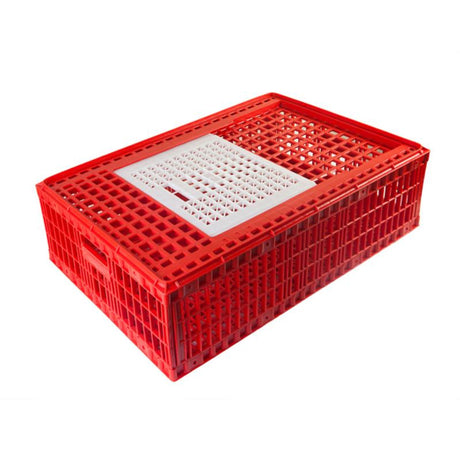
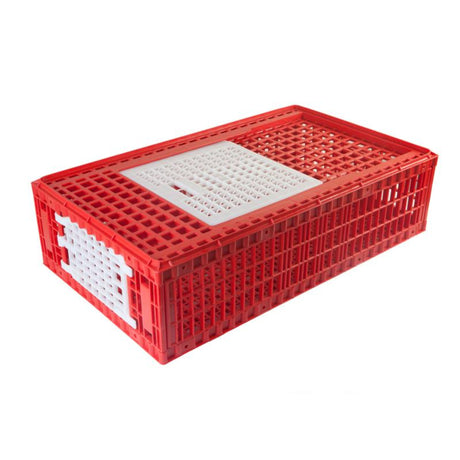
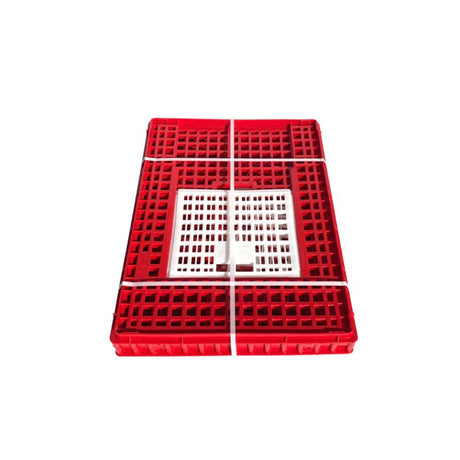
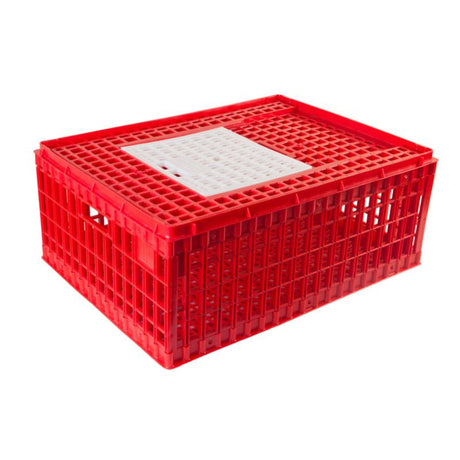
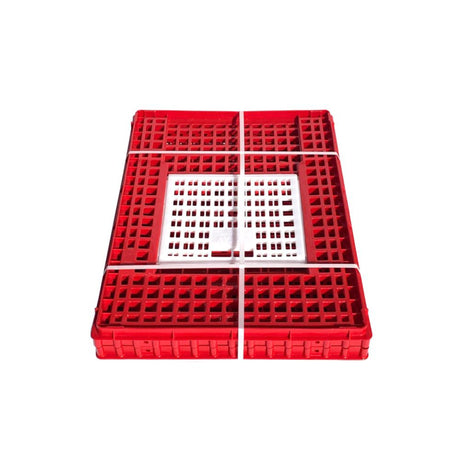
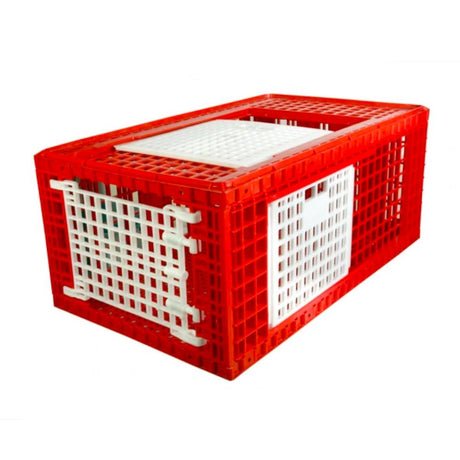
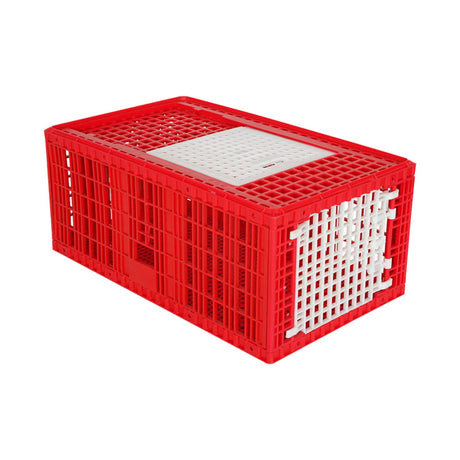
For planned transport, a proper poultry carrier is easier to manage because it gives you secure closure, ventilation, and a rigid structure that stays in shape while you load, move, and unload the birds. You may also see these called chicken transport crates, poultry transport crates, chicken carriers, or transport coops. The name matters less than the setup.
Look at the actual carrier. Can air move through it? Does the door close securely? Is there enough room for the birds to sit and move without being crowded? And once it’s inside the car, truck, or trailer, can you position it without blocking the ventilation?
University of Wisconsin-Madison Extension recommends sturdy, well-ventilated carriers with secure latches and enough room for birds to stand and turn.[2]
That ventilation part is easy to overlook. A crate can have openings on every side and still end up with poor airflow if you wedge it against boxes, bags, blankets, or another solid surface.
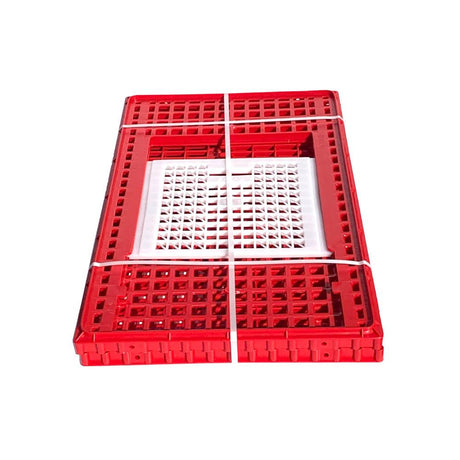
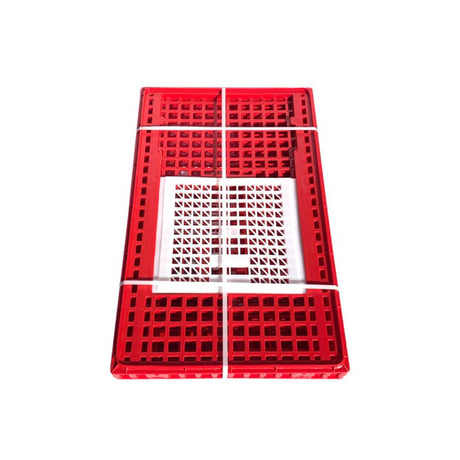
For regular transport, reusable plastic coops also make the cleanup side much easier. After the trip, you can wash and disinfect them properly instead of trying to reuse something that was never meant to carry poultry in the first place.
Hatching Time’s poultry transport coops include options for chickens, turkeys, quail, pigeons, partridge, and other game birds.
How Many Chickens Can You Transport at Once?
This is one of those questions where the most accurate answer is also the slightly annoying one: it depends on the chickens.
Ten bantams and ten heavy meat birds don’t occupy the same amount of space. Neither do ten birds traveling for fifteen minutes on a mild morning and ten birds spending several hours on the road in summer.
Virginia Tech’s review of broiler transport research recommends keeping birds upright in a single layer with enough room to sit comfortably. It also notes that appropriate crate stocking density depends on bird size and weather conditions.[1]
That’s a much more useful way to think about capacity than chasing one magic number.
| Flock Size | What to Plan For |
|---|---|
| 5 to 10 chickens | One appropriately sized carrier may work, depending on the birds and the model. |
| Around 20 chickens | Plan to divide the flock across carriers instead of trying to squeeze everyone into one crate. |
| Around 50 chickens | Work out carrier count, vehicle space, airflow, and loading order before catching birds. |
| 100 chickens or more | Think about the entire transport setup, including carrier count, vehicle space, ventilation, loading, and unloading. |
If you’re moving 50 chickens, this stops being a “which crate should I buy?” question pretty quickly. You need to know how many carriers fit safely in the vehicle, whether air can reach them, which birds are going where, and how you’ll unload everything when you arrive.
And don’t use the product capacity as a challenge. Hatching Time’s chicken transport coops currently list capacities between 10 and 16 chickens depending on the model. Those are manufacturer-listed capacities. The number you actually load should still make sense for the size and breed of your birds, the weather, and the trip itself.
How to Prepare Chickens Before Transport
Get the vehicle ready before you start catching birds.
Put the transport coops where they’ll actually sit. Check the doors. Check the closures. If you’re using several carriers, make sure they fit together without covering one another’s ventilation.
Then look at the weather.
Where will the chickens be while you’re driving? Will direct sun hit that part of the vehicle? What will the temperature be when you leave, and what is it likely to be a few hours later?
If you can choose your timing, cooler parts of the day are usually easier on birds in warm weather. And never leave loaded poultry sitting in a hot vehicle.[2]
For a larger flock, count your birds and carriers before loading. Realizing that your last ten chickens have nowhere to go is considerably easier to avoid than to solve once the first 40 are already inside crates.
This is also a good time to think about the floor of the carrier. Clean, dry bedding such as shavings, straw, or paper can give birds better footing and absorb droppings during transport.[2] Just make sure whatever you use works with the carrier design and doesn’t block ventilation.
Prepare the destination too. You want to arrive knowing exactly where the birds are going, whether that’s a closed coop, run, barn, processing area, or another secure enclosure.

How to Load Chickens Into a Transport Coop
Have the carrier open and ready before you pick up the bird.
Chasing a chicken around while somebody else assembles the crate adds stress to a situation that doesn’t need any more of it.
If possible, lower the light before catching. Virginia Tech’s review recommends that catching broilers in dim light reduces activity and distress, while higher light intensity can increase acute stress responses.[1]
Handle the bird calmly and keep it upright. Research reviewed by Virginia Tech found welfare benefits from upright handling compared with inverted handling, including lower fear and fewer injuries.[1]
Door design starts to matter here.
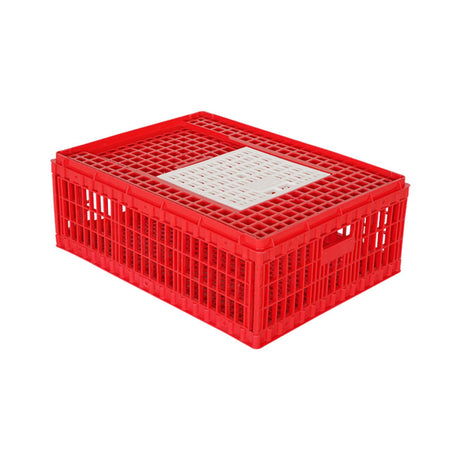
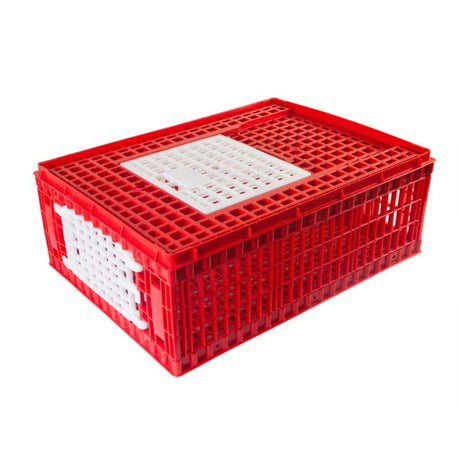
A sliding top door lets you control how much of the opening is exposed while loading. If several birds are already inside, that smaller opening can make the next chicken less likely to become the first chicken to escape.
A second front or side door gives you another option when you need to reach a particular bird.
For example, the Chicken Transport Coop (Small) with Two Doors has a sliding top door plus front access and lists capacity for 10 to 14 chickens. The Chicken Transport Coop (Large) with Two Doors uses the same basic access setup in a longer 38-inch carrier with a listed capacity of 12 to 16 chickens.
Once the birds are loaded, check every door again.
Do it while the carrier is still sitting in front of you, not after the vehicle has started moving.
How to Transport Chickens in a Car
Put the transport coop somewhere stable.
It shouldn’t be able to slide across the vehicle floor, tip during a corner, or move forward when you brake.
Then look at the ventilation again, because this is one of those things that’s easy to get right before loading and accidentally ruin afterward. A blanket, bag, box, or another carrier can cover the openings that were supposed to provide airflow.
The temperature where you’re sitting isn’t necessarily the temperature where the birds are sitting either.
Keep the carriers in a well-ventilated part of the vehicle, and check them during longer trips. In hot weather, avoid leaving birds in a parked vehicle even for a short stop.[2]
Direct sunlight through a vehicle window matters too. One carrier can be shaded while another is sitting in sun only a few feet away.
And drive like you have live animals in the back. Smooth turns, gradual braking, and normal acceleration give the birds less movement to compensate for inside the carrier.
Short Trips vs. Long-Distance Chicken Transport
Moving chickens ten minutes down the road and driving them for several hours aren’t the same problem.
On a short trip, you still need secure carriers, airflow, appropriate space, stable placement, and sensible temperature control.
As the trip gets longer, you need to think more carefully about how often you’ll check the birds, where you can stop safely, and how you’ll handle water without creating an escape problem.
Longer poultry transport is associated with greater risks of thermal stress, dehydration, weight loss, and other welfare problems, so trip length should be part of the plan rather than an afterthought.[1]
That doesn’t mean opening a full carrier beside a highway because you suddenly decide everyone needs checking.
Know where you can stop before you leave. Think about how you’ll reach the birds safely and what the weather is likely to do during the trip.
If you’re transporting birds specifically for processing, follow guidance for that situation. Preslaughter transport has its own timing, feed, water, and handling considerations that don’t automatically apply to moving a breeding flock or taking a few chickens to a show.[1]
Heat, Cold and Ventilation During Chicken Transport
Weather can change what would otherwise be a perfectly reasonable transport setup.
In warm conditions, airflow becomes particularly important. Chickens that are too warm may spread out and pant. When they’re too cold, they may huddle together. Virginia Tech also identifies poor ventilation, crate density, weather, and transport duration as factors that can affect poultry welfare during transport.[1]
This is also why stacking carriers deserves some thought.
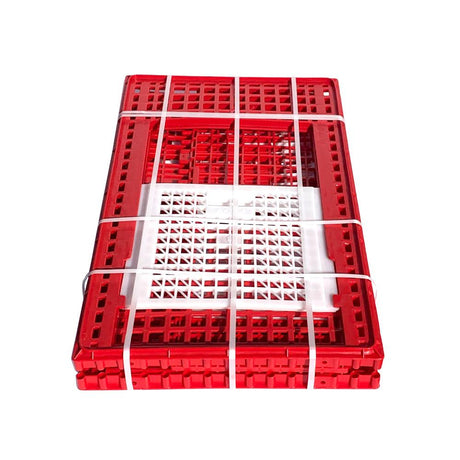
Most Hatching Time transport coop designs are stackable, but that only helps if the stack is stable and air can still reach the ventilation openings.
Don’t pack the vehicle so tightly that the crates technically fit but no longer have breathing room around them.
Cold creates a different problem. More airflow isn’t automatically better if the birds are sitting in strong cold drafts or getting wet.
Watch the birds themselves.
If they’re panting, spreading apart, huddling tightly, or behaving very differently from when you loaded them, don’t assume everything must be fine because the dashboard temperature looks comfortable.[1]
Which Chicken Transport Coop Fits Your Flock?
Start with how you actually handle your birds.
If you normally load the entire group and let them all out together at the destination, a simple top-door model may be enough.
If you regularly need to reach one bird without opening the whole carrier, an additional front or side door becomes much more useful.
Size matters too, but bigger isn’t automatically the answer. You’re choosing for the birds, the number you’re moving, the vehicle space you have, and the way you expect to load and unload them.
The capacities below are the figures currently listed on Hatching Time’s product pages. Treat them as manufacturer-listed capacities rather than a target you have to reach.
| Chicken Transport Coop | Listed Capacity | Dimensions | Access |
|---|---|---|---|
| Chicken Transport Coop with Top Door | 12 to 16 chickens | 30.5 × 22.5 × 10.6 in | Sliding top door |
| Chicken Transport Coop (Small, Deep) with Top Door | 10 to 14 chickens | 30.5 × 22.5 × 12 in | Sliding top door |
| Chicken Transport Coop (Small) with Two Doors | 10 to 14 chickens | 30.5 × 22.5 × 10.5 in | Top + front |
| Chicken Transport Coop (Large) with Top Door | 12 to 16 chickens | 38 × 22.5 × 10.6 in | Sliding top door |
| Chicken Transport Coop (Large) with Two Doors | 12 to 16 chickens | 38 × 22.5 × 10.7 in | Top + front |
| Chicken Transport Coop (Large) with 3 Doors | 12 to 16 chickens | 37.8 × 22.5 × 10.6 in | Three access points |
There’s no reason to choose three doors simply because three sounds better than one.
Ask what actually happens when you move your birds.
Do you need to reach one chicken in the middle of a group? Do you unload into a space where side access would be easier? Do you usually open the carrier once and let the whole group out?
That’s the difference that matters.
If you’re still deciding between sizes and door configurations, you can compare the full Hatching Time Transport Coops collection.
Transporting Turkeys, Quail, Pigeons and Game Birds
A chicken carrier isn’t automatically the right carrier for every bird you raise.
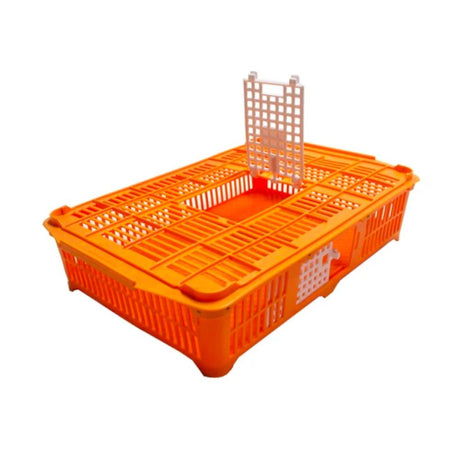
Turkeys need more height. Quail and pigeons are considerably smaller. Game birds such as quail and partridge need equipment sized around their bodies rather than around an adult chicken.
| Birds | Transport Option | Listed Capacity / Use |
|---|---|---|
| Turkey | Turkey Transport Coop (Large) with Two Doors | 3 to 4 turkeys |
| Turkey | Turkey Transport Coop (Large) with 3 Doors | 3 to 4 turkeys |
| Quail / pigeon | Quail & Pigeon Transport Coop | Designed for quail, pigeons, and similarly sized birds |
| Quail / partridge | Gamebird Transport Coop with Two Doors | Up to 18 quail or 10 partridge |
The size difference between these products is meaningful. The turkey models are 16.5 to 17 inches high, compared with roughly 10.5 to 12 inches across the chicken models. The Gamebird Transport Coop is only 5.6 inches high.
Choosing by species and bird size makes more sense than simply buying the biggest carrier you can fit in the vehicle.
Transporting Chickens Across State Lines
Crossing a state line adds one more thing to your preparation: check the current rules before you leave.
USDA APHIS states that interstate transportation of poultry must meet federal animal-movement requirements, and most states have additional entry requirements. Depending on your destination and circumstances, a certificate of veterinary inspection or entry permit may also be required.[3]
NPIP status and poultry disease requirements can also be relevant, depending on the birds and destination state.[3]
Those rules can change.
This is one situation where an old forum answer isn’t good enough. Check the destination state’s current requirements and contact the appropriate state animal health office if you’re unsure.

Unloading Chickens After the Trip
Arrival isn’t the moment to stop planning.
Before opening the carrier, make sure the area around you is secure. A closed coop, run, barn, or other contained space gives you much more control than opening a transport crate in an open yard.
Move slowly and give yourself enough room to handle the birds.
This is another point where multiple doors can be useful. If the carrier has front or side access, you can choose the opening that works best for the space instead of always reaching down through the top.
Once the birds are out, give them access to the housing, water, and normal care appropriate for their destination.
And don’t leave them sitting in transport crates simply because the driving part is finished. The carrier did its job. Now the birds need to settle into the space they were actually traveling to.
Cleaning and Disinfecting Poultry Transport Coops
If you’re going to reuse the carrier, clean it after the trip.
And do it in the right order.
USDA APHIS recommends removing manure, feathers, dirt, bedding, and other debris before washing. Disinfectant can’t work properly through organic matter or caked-on dirt.[4]
After the dry debris is gone, scrub the surfaces with water and detergent, rinse thoroughly, apply an appropriate disinfectant according to its label, and let the carrier dry completely before birds use it again.[4]
Reusable plastic transport coops make this process much easier because their surfaces can be washed between uses.
Cleaning matters even more if the carrier has been to a show, fair, auction, market, processing facility, or anywhere else where birds from different flocks have been present.
You don’t want whatever came home on the carrier becoming part of your flock’s environment.
Common Chicken Transport Mistakes
A lot of transport mistakes aren’t dramatic. They’re small decisions that start stacking up.
| Mistake | What Goes Wrong |
|---|---|
| Filling the crate simply because more birds physically fit | Bird size and weather still affect appropriate stocking density.[1] |
| Blocking carrier ventilation | A ventilated carrier can’t help much if air can’t reach the openings. |
| Leaving loaded carriers in a hot vehicle | Vehicle temperatures can become unsafe quickly, even if the trip itself is short.[2] |
| Ignoring the carrier floor | Clean, dry bedding can improve footing and absorb droppings during the trip.[2] |
| Catching birds before the vehicle is ready | Birds spend longer being handled or waiting inside carriers. |
| Choosing by maximum capacity alone | Dimensions, breed, bird size, weather, and door configuration matter too. |
| Leaving carriers unsecured | The crate can still slide or tip even when every door is closed. |
| Storing a dirty carrier after the trip | Manure, feathers, and other organic debris make proper cleaning and disinfection harder later.[4] |
Before catching the first chicken, ask yourself a few very ordinary questions.
Where is this carrier going to sit? Can air reach it? How many birds am I actually moving? How am I getting them out at the other end?
If you can answer those before loading starts, the trip usually becomes much simpler.
References
- Samantha Vitek and Leonie Jacobs. Preslaughter Welfare of Broiler Chickens. Virginia Cooperative Extension, Virginia Tech and Virginia State University. 2025. Read the source.
- University of Wisconsin-Madison Extension, Barron County. Barron County 4-H Poultry Project: Transporting Birds. Guidance on ventilated carriers, bedding, overcrowding, space, and hot-weather transport. Read the source.
- USDA Animal and Plant Health Inspection Service. NVAP Reference Guide: Interstate Regulations. Current federal guidance on interstate animal and poultry movement and state entry requirements. Read the source.
- USDA Animal and Plant Health Inspection Service. Build a Clean Routine. Guidance on removing debris, washing, rinsing, disinfecting, and drying poultry enclosures and equipment. Read the source.
Written by:

Elif Oztuna