
Table of Contents
Incubating eggs seems like a very straightforward process, but would you believe there can be differences between breeds, egg size, shell color, and individual breeding groups that show up during the incubation process?
Whether you're a seasoned professional or a beginner, hopefully this insight into the Fine Tuning process will make your next hatch even more successful!
The standard recommendations still give us our starting point. Mississippi State Extension recommends 100°F for chicken eggs in a forced-air incubator.1 If you are still getting comfortable with the basics, Hatching Time's guide to temperature and humidity for hatching chicken eggs covers those starting settings in more detail.
REPLICATING MOTHER HEN
In the natural order of things, the mother hen will gather her clutch of eggs and spread out her body over them. A broody hen develops a naturally bare patch on her chest, which lets her body heat reach the eggs more directly.2
She does get up and leave the clutch, and I like to remind people of this when they are nervous about candling.
Illinois Extension recommends keeping eggs out of the incubator no more than about 5 to 10 minutes at a time. If you have two dozen eggs in the incubator, they suggest candling only about 5 to 7 eggs at one setting.3
So be organized, but you don't have to panic every time an egg is out for a few minutes.
If you are newer to this part of incubation, Hatching Time's egg candling guide walks through what you may see as development progresses.
Mother Hen is doing all her final preparations and is Fine Tuning her process to get ready to sit for the next 21 days.

SET UP
When incubating multiple breeds in an incubator, and/or multiple colors of eggs, the first setup for success is to separate the eggs out by breed and color when you can.
If you have the ability to run multiple incubators, this also gives you the option to separate breeding groups and compare how each group performs from hatch to hatch.
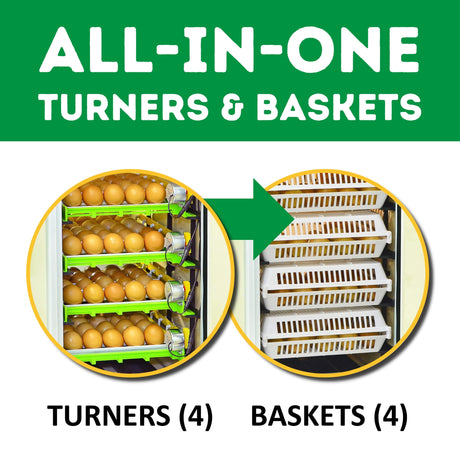
If you are trying to separate them in the same incubator, there are different schools of thought for how to do this best. If you have several different colors, more than your Hatching Time trays can accommodate, separating them with modifications to the trays and/or mesh bags is how we have done it in our own hatch room.

These are DIY methods we use ourselves, not official Hatching Time tray modifications, so anything added inside an incubator needs to be positioned so it does not interfere with airflow, egg turning, equipment operation, or chick safety.
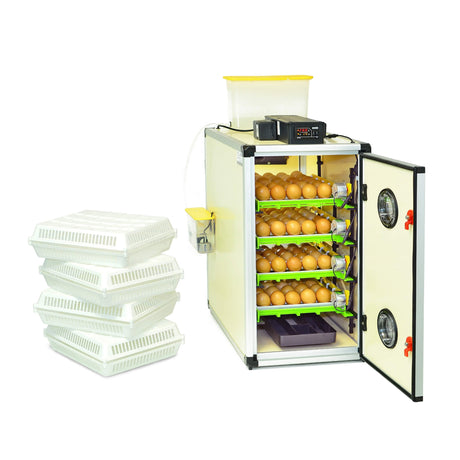
We run our Hatching Time CT120 this way because keeping groups identifiable later makes our records much more useful.
There is another piece of Chicken Math I have to keep in mind. If I always put the same breed in the same incubator or the same part of the cabinet, I can accidentally create my own pattern.
Was it really the breed, or was that incubator running a little differently?
That is not just theoretical. One incubation study found differences among incubators in hatch timing, and Illinois Extension notes that a low average incubation temperature can delay a hatch.35
One thing I want to do more of is switch breeding groups between machines or tray positions on later hatches and see whether the pattern follows the eggs. At the very least, I record which incubator and position each group was in.

MAKE A RAINBOW
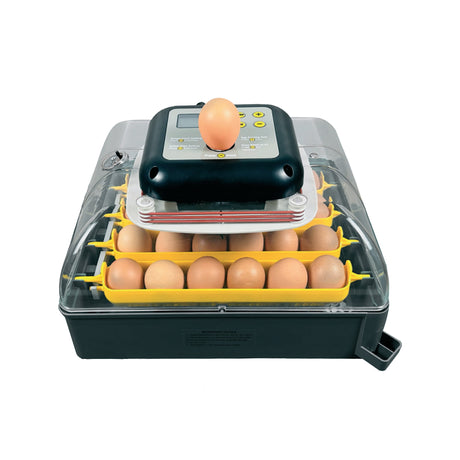
When choosing which trays to put which breeds in, we choose to put our lightest colors at the bottom of the cabinet-style incubator, like the CT120 Setter & Hatcher, and we put the darkest eggs at the top.
We call this making a rainbow.
This is how we organize our own hatches, and it makes it much easier for us to keep track of breeds and compare results afterward.
I used to think of this mainly as a humidity difference between dark and light eggs. I would explain it differently now.
In one study using similar-weight brown eggs from a commercial meat-type breeder flock, researchers did not find that darker brown pigmentation by itself changed incubation weight loss or hatch time.4
That is not the same thing as testing a 7, 8, or 9 on the Marans Color Chart.
The same study did find some differences in hatchability when shell pigment was combined with illuminated incubation, so I don't take the research to mean shell color can never matter. I take it to mean shell darkness alone is not enough information to decide humidity or hatch timing.4
So yes, we still make our rainbow.
It works for us.
But I use it as a way to organize and compare breeding groups, not as a rule that every dark egg belongs on top and every light egg belongs on the bottom.
HOSPITAL TIME ZONES
Hatching is similar to labor and due dates!
When you go to the hospital, time seems to stand still and/or not happen according to our timing.
Same is true for "Hatch Day."
Even though hatch for chickens is "in 21 days," some come earlier, some come right around day 21, and some are perfectly happy to make us wait.
Once you work with hatching a breed or a breeding group long enough, you will begin to notice:
"Oh look, the so-and-so's hatched first."
And/or:
"I don't even see any pipping on the so-and-so's despite it being hatch day."
You're ready for Fine Tuning!
Research has found differences in incubation time between chicken strains, but the size of those differences matters. In one study of commercial broiler breeder strains, mean incubation times differed by only about 2 to 3 hours between strains, not days. The strain effect was significant in the first experiment but not the second.5
Those were commercial broiler breeder strains, not Polish or Black Copper Marans. So the research does not prove that every breed has its own timetable. It gives me one more reason to record what happens rather than assume every group will behave exactly the same.
For a closer look at the normal hatch window, see Hatching Time's guide to how long chicken eggs take to hatch.

WATCH OUT FOR PITFALLS
Most advice available on the internet will suggest a standard in humidity and temperature.
That is where I think everybody should start.
The pitfall is deciding that one strange hatch means a whole breed needs a completely different temperature.
Temperature especially is not something I change casually by breed. Mississippi State recommends 100°F for chicken eggs in a forced-air incubator, and temperatures that remain too high or too low can affect hatch timing and hatch success.1
Humidity is something I pay close attention to because different eggs can lose moisture differently, but even there I want records before I decide one breeding group needs a different routine.
Also, do not assume a zero hatch automatically means the breed needed a different setting.
Sometimes fertility is off due to weather events. Sometimes eggs were stored or handled differently. Sometimes it's operator error and sometimes it is inexperience. Temperature, humidity, turning, sanitation, breeder condition, and embryo mortality can all be part of the story.
Do your research, keep your records, and look at what happened before you change everything.
FINE TUNING EXPERIENCES
Chicken Math Professor specializes in Chicken Math and hatching.
We run the Cimuka CT120 and in prime hatching season, in addition to the CT120, we run three Maticoopx incubators, a Kebonnixs, and a Brinsea incubator.
We set eggs by incubator and by what we know about our breeding groups.
For example, our Black Copper Marans, especially the 7 to 9 eggs on the Marans Color Chart, are one group I have learned to handle differently based on our own hatch history.
I tend to run these eggs more conservatively on humidity, and I don't bother them regularly.
And they make us wait.
In our setup, we have had Black Copper Marans not start to pip until day 22 or even day 23!
And day 22 or 23 is not automatically outside the chicken hatch window. Illinois Extension advises leaving unhatched eggs in the incubator until day 23 or 24.3
That doesn't make late hatching a Marans rule, but it does mean I don't give up just because day 21 passed.
That is what we see in our breeding program.
I would not say dark pigmentation itself is what causes the later hatch, and I would not say every Black Copper Marans egg should automatically be run at lower humidity.
The brown-pigment study I mentioned earlier used similar-weight eggs from a commercial meat-type breeder flock, not extremely dark Marans eggs. Within that study, shell darkness itself did not change hatch timing.4
So when I tell somebody that our Marans take longer, I mean our Marans.
In our hatching experience, we also noticed that invariably, around day 20.5, almost every Polish hatching egg that we set was already hatched!
Even though we were still waiting for almost every other egg to even start pipping, the Polish were already hatched!
Then we started looking at egg size.
In our own breeding groups, the Polish eggs were around 48 grams for a full-sized Polish hen's egg. Our American Bresse eggs were around 52 grams, Rhode Island Reds around 55 grams, and some of our Black Copper Marans eggs approached 80 grams.
Those are measurements from our flock, not official breed-standard egg weights.
Could egg size be part of what we were seeing?
That was one of my first thoughts, but the research did not give me the simple answer I expected.
In the Suarez study, heavier eggs were actually associated with shorter incubation time, not longer incubation time. Breeder age was tied into that relationship too, and the researchers found that genotype, breeder age, and incubator all needed to be considered together.5
So the size difference does not explain why our Polish keep showing up early.
It just gives me one more thing to record.
I would never tell someone:
"Polish hatch at day 20.5."
I can tell you:
"Our Polish kept doing it."
And once something keeps happening, I want to keep watching it.
ENJOY THE JOURNEY
Each hatching experience will bring victories, awe, and even possibly heartache, adding to your repertoire of what to expect for future hatches.
Enjoy the process and share your techniques that have been tried and true and enabled you to Fine Tune hatching by breeds.
For me, the biggest lesson has been not to change settings just because one hatch surprised me.
Start with the standard incubation recommendations.
Keep track of which eggs came from which breeding groups.
Pay attention to what happens.
Record which incubator and tray position they were in.
And if you think you've found a pattern, move things around on another hatch and see if the pattern follows the eggs.
Then see if the chickens are kind enough to repeat it for you.
References
- Mississippi State University Extension Service. Hatching Quality Chicks.
- University of Maryland Extension. Hatching Eggs at Home (FS-1114).
- University of Illinois Extension. Incubation and Embryology Q & A.
- Shafey, T. M., Al-Batshan, H. A., Ghannam, M. M., & Al-Ayed, M. S. Effect of Intensity of Eggshell Pigment and Illuminated Incubation on Hatchability of Brown Eggs. British Poultry Science, 2005.
- Suarez, M. E., Wilson, H. R., Mather, F. B., Wilcox, C. J., & McPherson, B. N. Effect of Strain and Age of the Broiler Breeder Female on Incubation Time and Chick Weight. Poultry Science, 1997.
Written by:

Kimberly Benjamin
https://ancient-path-acres.square.site/